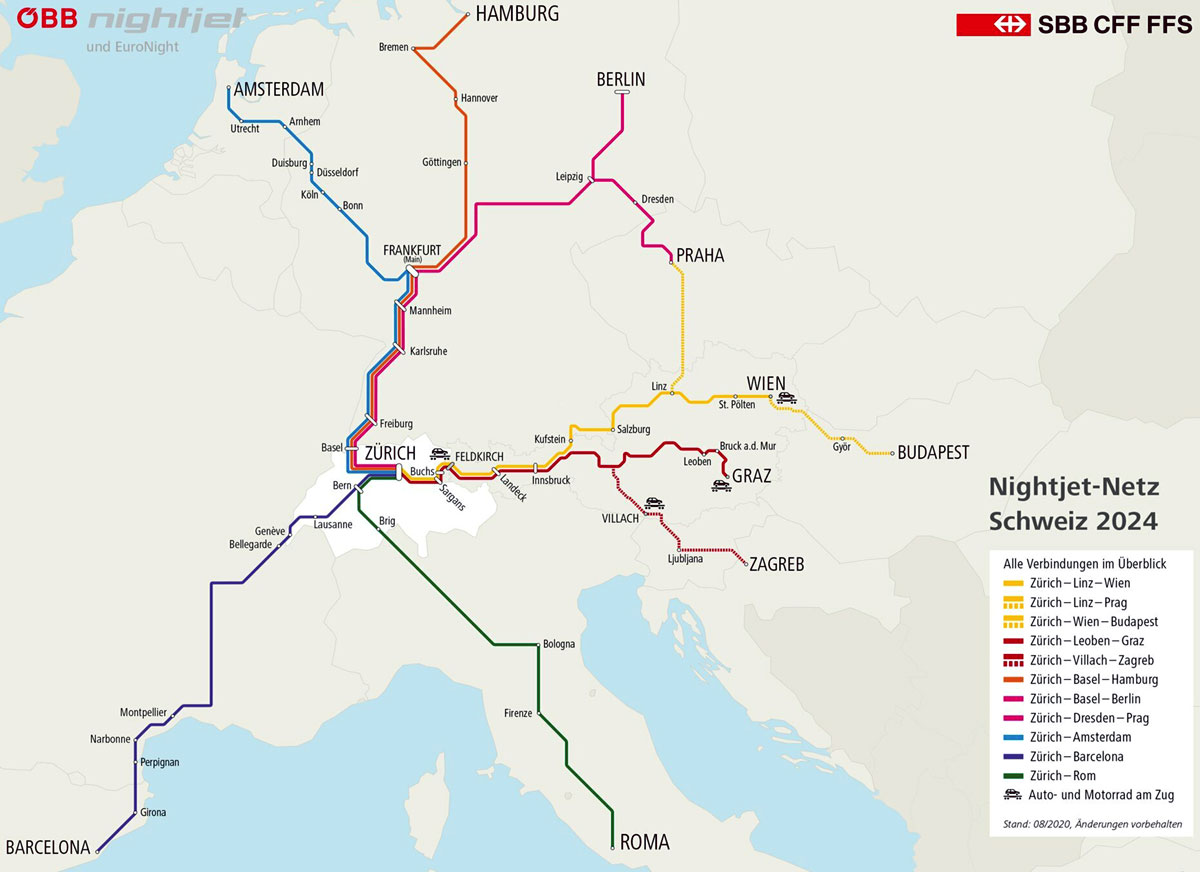
The Swiss Railways SBB joins ÖBB using the Nightjet trademark to deliver high-quality night sleeper trains connecting Zürich with various European cities.
An expert traveller blogs about locomotives, scenic railway journeys and photography.
Showing posts with label train. Show all posts
Tuesday, 15 September 2020
Friday, 8 May 2020
Photo of the Week: CFF Viseu
CFF Viseu de Sus is a narrow-gauge forestry railway situated in Northern Romania, in the Carpathian Mountains. In the warm half of the year, every weekend tourist steam trains take over the valley of the Vaser river and there are some occasional winter runnings as well. On weekends the railway still serves the original purpose, transporting lumber and lumberjacks. The excursion trains visit about half the length of the railway from Viseu to Paltin. Most steam locomotives used were at Resita or Reghin in Romania as a variant of the Hungarian MÁVAG class 490 design.
Labels:
narrow-gauge railway,
photo,
photooftheweek,
railway,
romania,
steam locomotive,
train
Location:
Vișeu de Sus, Romania
Tuesday, 6 August 2019
Retro Liveries of the Locomotives of the Hungarian State Railways
Retro is a term often used in Eastern and Central Europe for things that are left behind from the end of the 20th century, or, in an increasing number of cases, have been recreated to resemble the typical looks of those things. Unlike 'old', retro doesn't imply that the thing is incapable of doing its job anymore, just identifies it as something which has a unique style to it because of the year it was made.
When talking about trains, we must differentiate between retro vehicles and historic vehicles, both can mean locomotives, carriages or multiple units and railcars. Something is historic if it is kept in a museum or is only used on special occasions. They are often privately owned or belong to an identity separate from the railway companies that serve the usual traffic in the region. Retro, on the other hand, usually means a vehicle that still has some daily work to do and is actively used to earn revenue in ways which are not connected to the tool being older than the average stock. To put it straight: they carry passengers just like any other vehicle belonging to their operator or are used for daily freight or departmental trains. But they all wear a special livery that can turn back the wheel of time for the people who remember, force some good memories to resurface and add a significant bit to the class and mood of rail travel. In the UK this kind of repainting is often called a heritage livery.
The Hungarian network is not the only one to have retro trains, but the number of such vehicles has greatly increased recently and for the second year in a row, passenger operator MÁV-START has organized special Retro Weekends for enthusiasts and the general public to enjoy, thus bringing attention to the existence of these nice vehicles.
Bzmot 343 (117 343 in the current numbering scheme) is allocated to the MÁV-START depot at Balassagyarmat and wears the livery these tiny railcars had worn until the mid-90s refurbishment and engine replacement.
Labels:
Balaton,
Bzmot,
electric locomotive,
historic train,
hungary,
locomotive,
locomotives,
m40,
M41,
M61,
M62,
máv,
nohab,
railway,
train,
v43,
vehicles
Saturday, 27 July 2019
Photo of the Week: Neretva River Gorge with Old Train
The Neretva Gorge is one of the most spectacular views of the Balkan and a highlight of the train travel from Sarajevo to Mostar in Bosnia and Herzegovina. The twice-daily trains used to be run by ASEA-license locomotives and an assorted set of carriages but nowadays the Spanish Talgo high-speed sets are mandatory. In the summer, extra trains are provided. See more about Bosnia and Herzegovina on my website.
Friday, 29 March 2019
The ÖBB 4020 electric multiple unit from Austria
S-Bahn train in the tunnel under Wien Hauptbahnhof (Vienna Main Station)
The Austrian Federal Railways (ÖBB) had electrified many railway lines at the very early days of mainline electrification choosing the then most-advanced low-frequency alternating current system with 15 kV, 16 (2/3) Hz AC voltage. The federal capital Wien was reached by electric trains in 1952 as the main area for electrification had been the mountain passes. In those years Austria was still under Allied occupation with the capital being inside the zone controlled by the Soviet Union but the city itself split up into four control zones very similarly to those of Berlin. But while Berlin and Germany gradually shifted into an Eastern and Western part Austria was jointly run by the four allies and in 1955 given independence.After that, the development of the city sped up and required the establishment of a commuter railway network which later incorporated various rail links inside the city and became the Vienna S-Bahn. The main vehicle on the S-Bahn became the ÖBB class 4030 electric multiple unit which had almost the same features as the subject of the present article, only being different in exterior design and the electric systems.
Labels:
4020,
austria,
cityrail,
electric multiple unit,
locomotives,
öbb,
railway,
s-bahn,
semmering,
semmeringbahn,
sgp,
train,
vehicles,
wien
Location:
Bécs, Ausztria
Sunday, 24 March 2019
Photo of the Week | The Schwarzatal-Viaduct
The Semmeringbahn is the world's first mountain mainline and a highlight of the European railway network. The whole line was designed to harmonize with nature and as such can be considered the first attempt to show that rail transportation is the green way to go. The route through the 898 m high Semmering Scheiteltunnel is soon going to start serving only the tourists after the opening of the new Semmering Base Tunnel (SBT). You should visit the Semmering Railway while it still has freight trains and railjet high-speed trains through the mountain pass.
Labels:
4020,
night,
night photography,
öbb,
photooftheweek,
railway,
semmering,
semmeringbahn,
train,
viaduct
Subscribe to:
Posts (Atom)


